Gradient Boosting (GB)
A scikit-learn Gradient Boosting classifier trained on KOI features to predict exoplanet candidacy with calibrated probability outputs and extensive hyperparameter tuning.
Dataset & target
- Data: KOI Playground train/test CSVs with astronomical measurements
- Target classes: candidate vs non-candidate
- Features include: koi_period, koi_prad, koi_teq, koi_insol, koi_dor, ... (full list in feature_names.csv)
Pipeline
- Explore and preprocess data (median imputation for numeric)
- Encode target variable
- Train baseline GB model
- GridSearchCV for hyperparameter tuning (primary metric: ROC-AUC)
- Final training and evaluation; export artifacts
Gradient Boosting is a reliable “tabular data” model. It learns from many small decision trees, each fixing the mistakes of the previous one.
What it does
- Reads KOI table features (period, radius, temperature, etc.)
- Predicts candidate vs non-candidate
- Gives a probability for confidence
When to use it
- You have a clean table (CSV) with the KOI features
- You prefer classic ML with quick training and simple deployment
Data needed
- Training and test CSVs (KOI features)
- Missing numeric values filled by median (simple and robust)
How it works (simple)
- Start with a simple tree
- Add small trees that focus on remaining errors
- Combine all trees to make a strong predictor
Tuning (common knobs)
- n_estimators (number of trees), learning_rate, max_depth, subsample
- Tune with cross-validation, using ROC-AUC or Accuracy
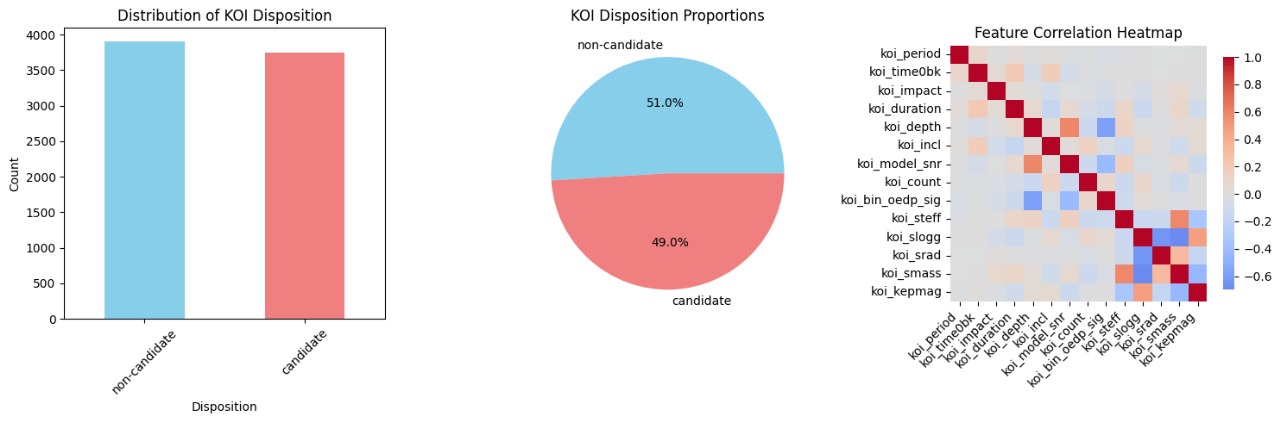
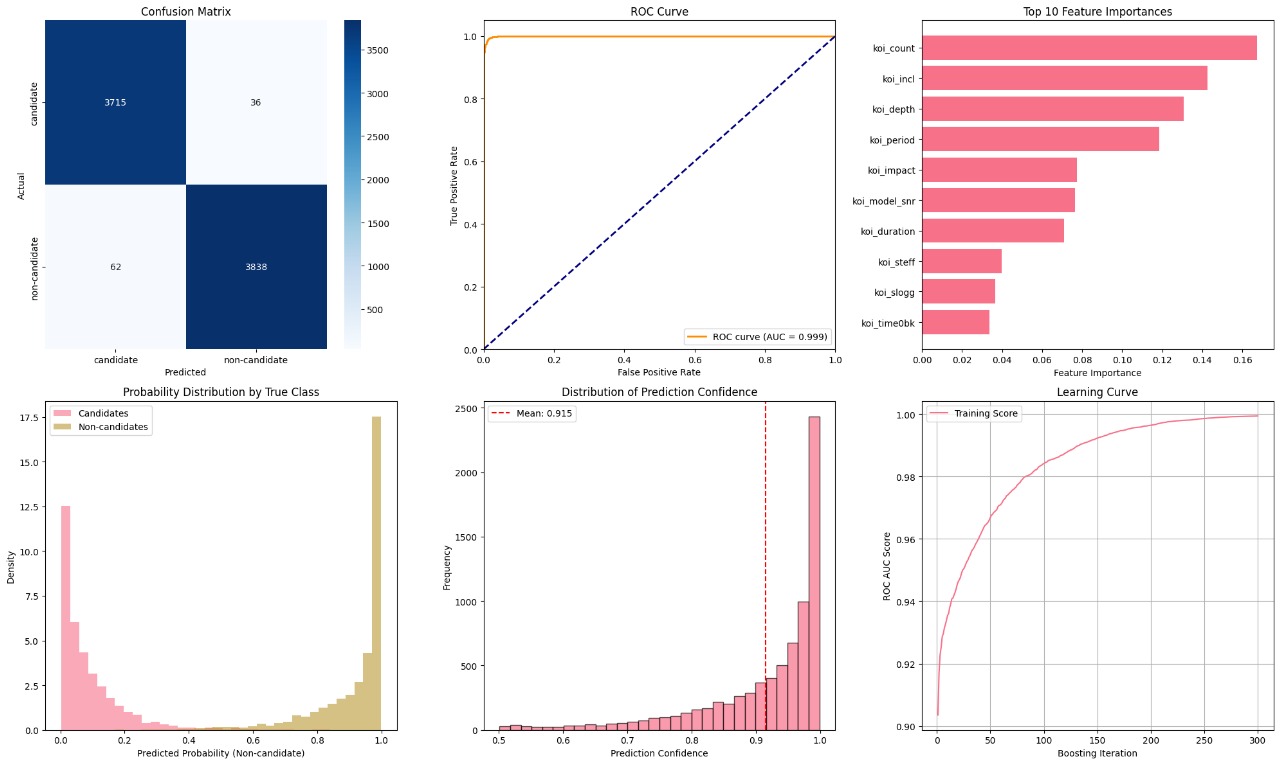
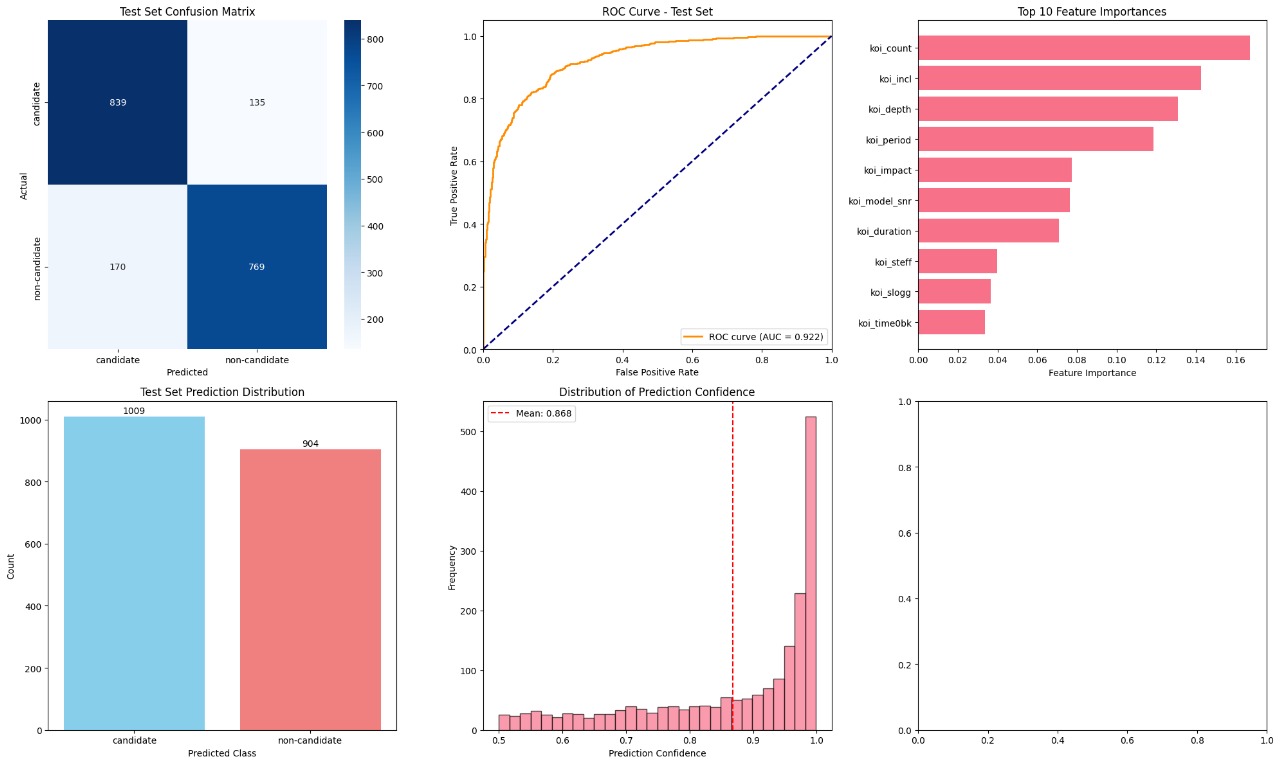
What you’ll see (example visuals)
Outputs (files)
- Model: exoplanet_gradient_boosting_model.joblib
- Label encoder: label_encoder.joblib
- Features list: feature_names.csv
- Predictions and metrics CSVs for reporting
Tips
- Match feature order to
feature_names.csv - Use the same preprocessing at training and prediction time