Dual-Input Deep Neural Network (DNN)
This DNN combines two views of the same star: the raw light curve and a set of simple, engineered numbers about that curve. Together, they make a stronger prediction.
What it does
- Uses the light curve to catch transit shapes
- Uses features (like variability and frequency) to add context
- Merges both to decide: CANDIDATE or FALSE POSITIVE
When to use it
- You have light curves and can compute basic features (we support 24+ common ones)
- You want better accuracy and explainability than using the curve alone
Data needed
- Light curve CSV per star → normalized to 3000 points
- Feature table per star → statistical, variability, frequency, transit features
How the model works (simple)
- Time-series branch (small CNN) learns shapes from the curve
- Feature branch (dense layers) learns patterns from numbers
- Both branches are merged → final dense layers → binary output
Architecture snapshot
- Time series: 1D conv → pooling → dropout → embedding
- Features: Dense → batch norm → dropout → embedding
- Merge: Concatenate → Dense → Sigmoid
What you’ll see (example outputs)
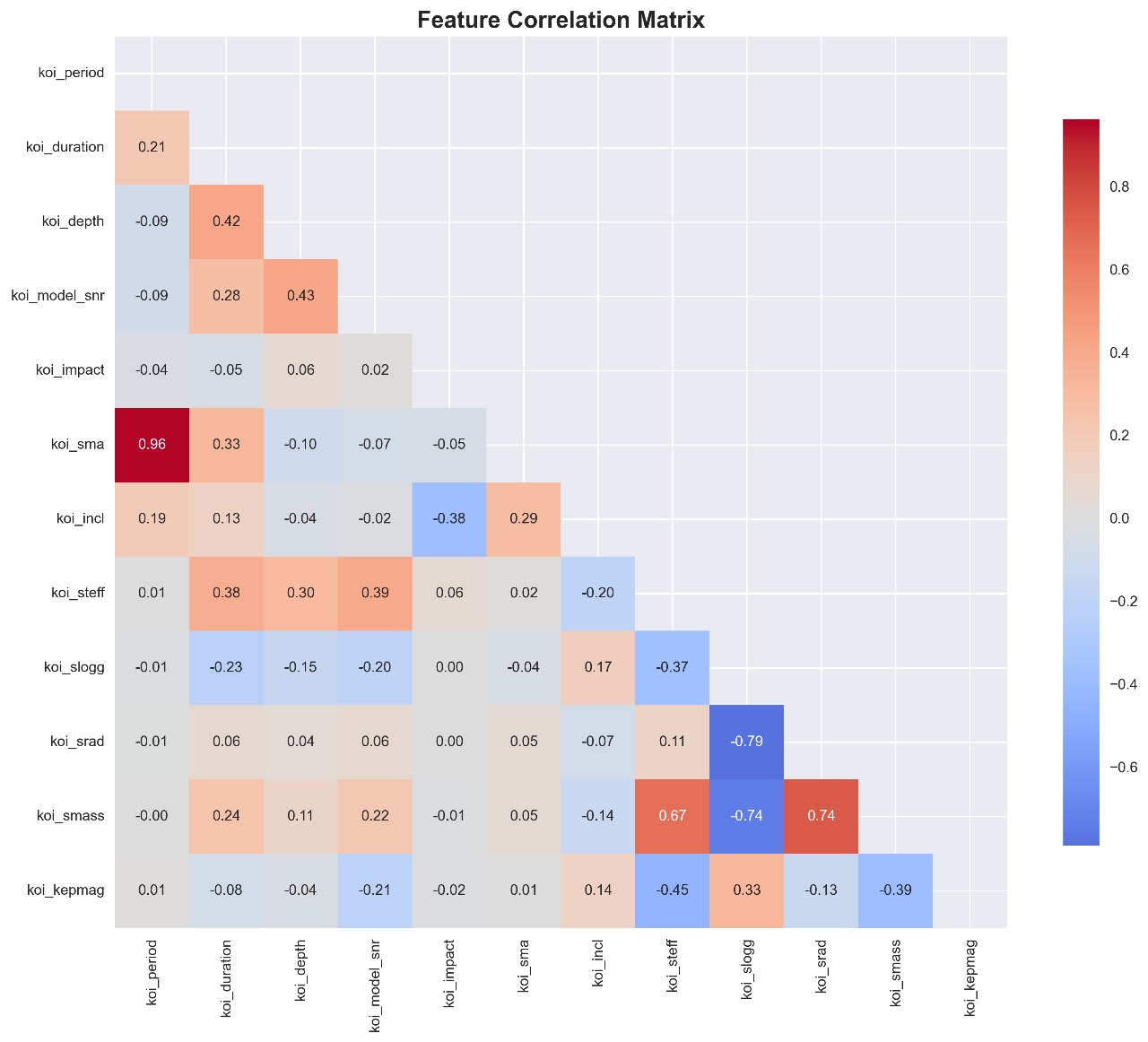
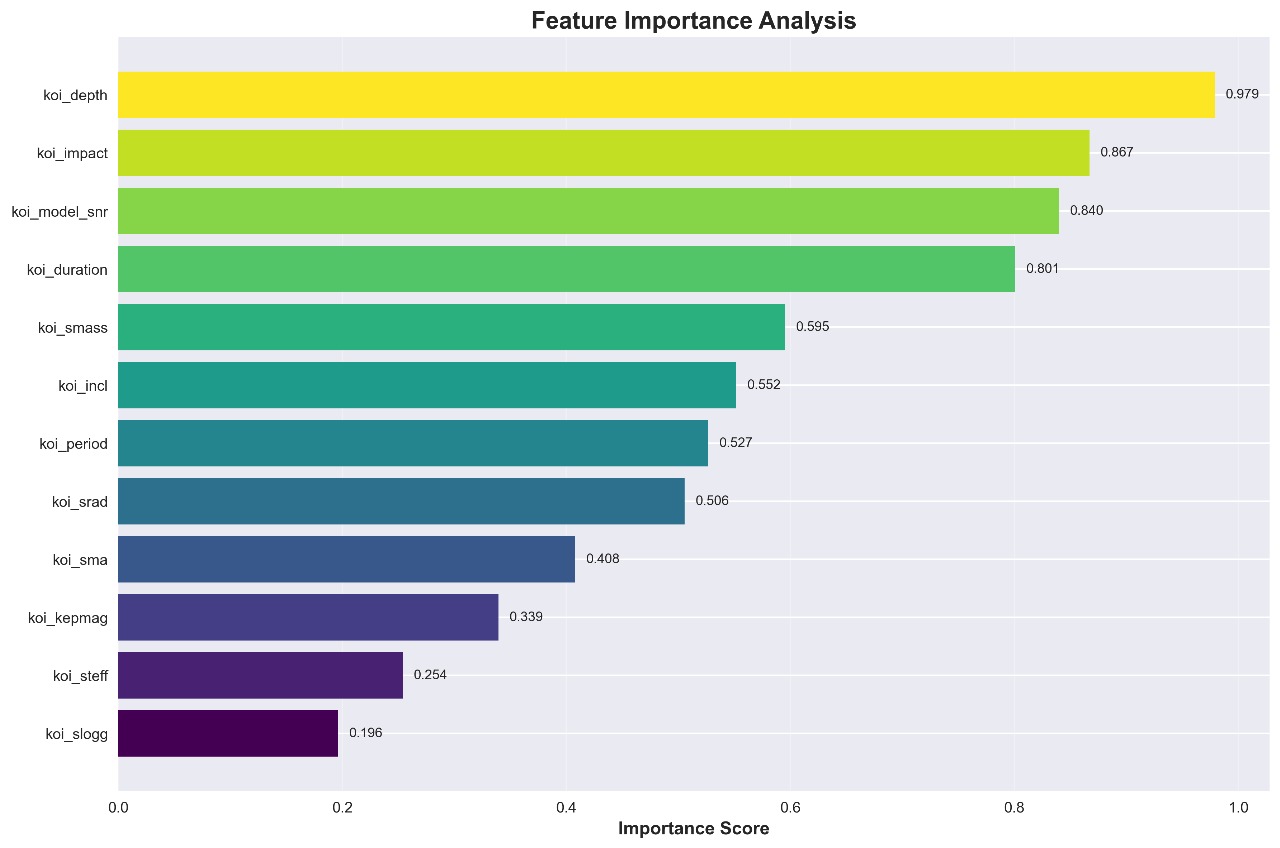
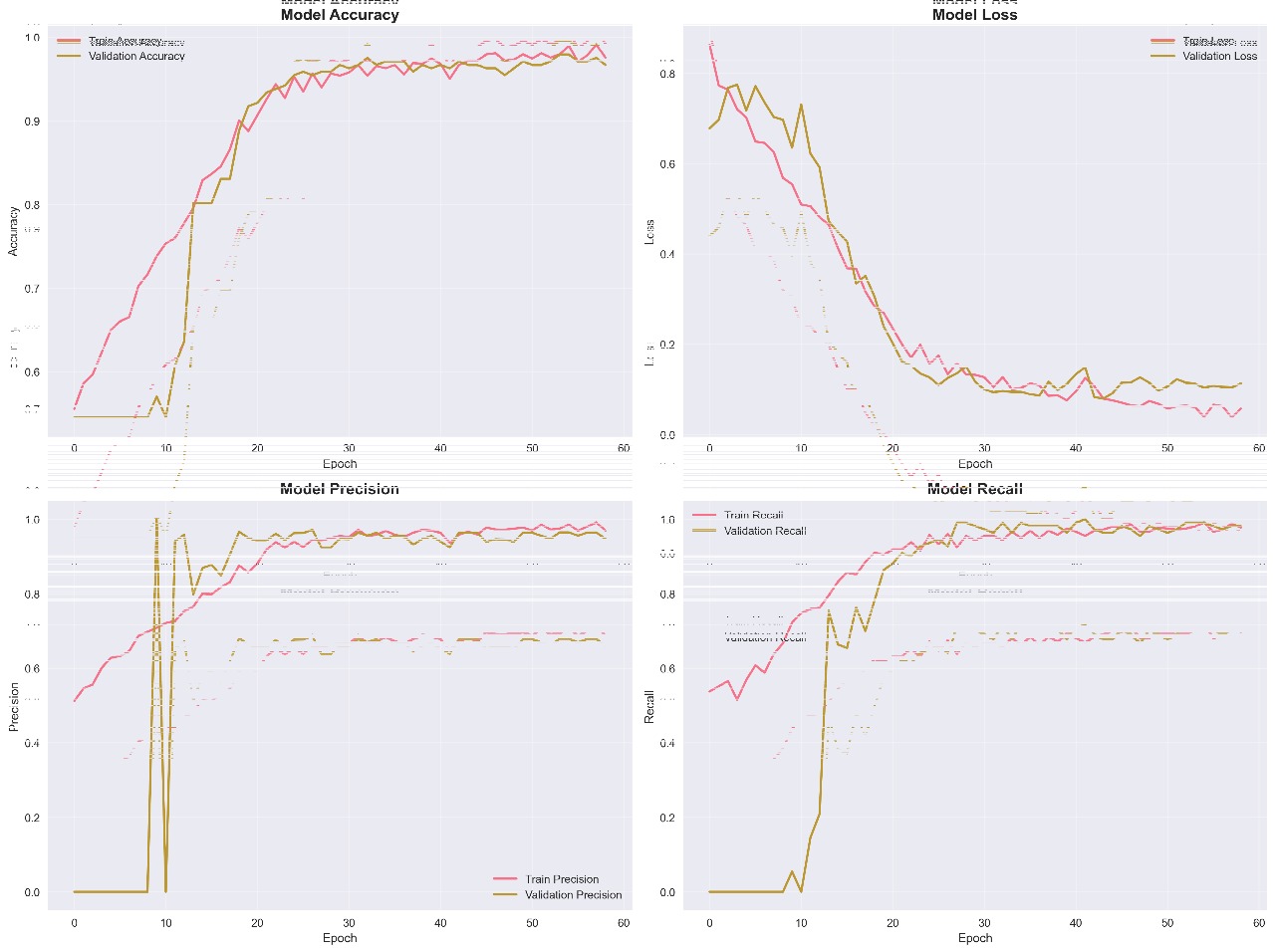
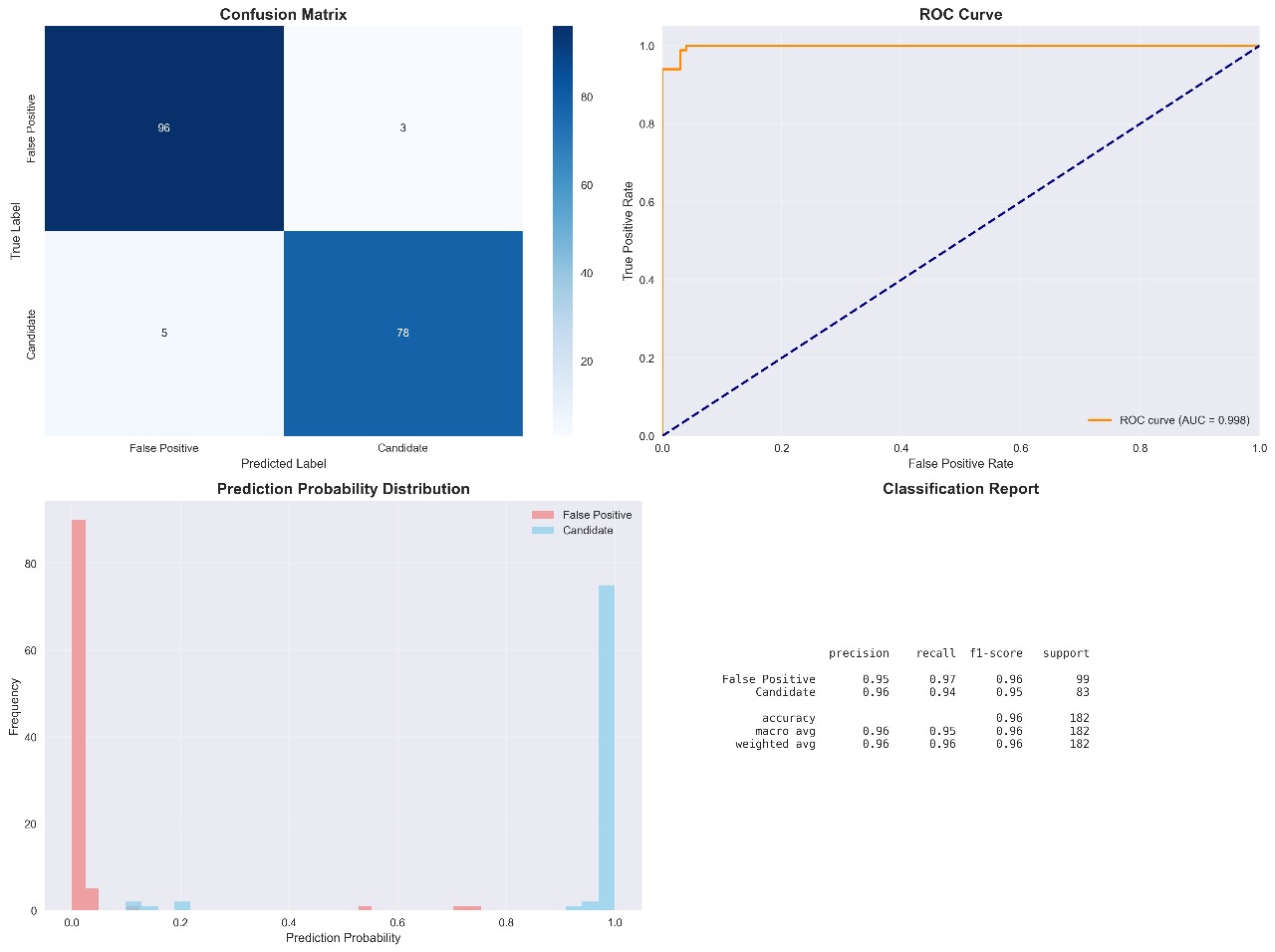
Typical results (example)
- Train ≈ 0.98 | Validation ≈ 0.97 | Test ≈ 0.96 (can vary by dataset)
Tips
- Keep preprocessing consistent between training and prediction
- Use SHAP plots to understand which features matter for a given star
A dual-branch DNN that fuses learned features from light curve time series with engineered tabular features. The pipeline includes feature extraction, preprocessing, and comprehensive explainability via SHAP.
Highlights
- Dual-input: 1) time series branch (CNN stack), 2) feature branch (dense stack)
- Robust preprocessing: missing data handling, outlier removal, robust scaling
- Explainability: SHAP for global and local feature importances
- End-to-end training script with configuration-driven hyperparameters
Architecture
- Time series branch: 1D conv + max pooling + dropout on 3000-point normalized sequences
- Feature branch: Dense layers with batch norm + dropout on statistical/astronomical features
- Fusion: Concatenation followed by dense layers to binary output (Candidate vs False Positive)
Data processing
- Light curves: normalize (median/MAD), sigma clipping, fixed length 3000
- Feature extraction: 24+ features
- Statistical: mean, std, median, skew, kurtosis
- Variability: amplitude, flux excursions, range
- Frequency: dominant frequency, spectral features
- Transit: dip detection, periodicity
- KOI catalog integration, imputation, scaling
Training pipeline
- Load + preprocess sequences and features
- Train/validation/test splits
- Build and train model with configured hyperparameters
- Evaluate metrics and generate SHAP explanations
Reported metrics (snapshot)
- Train acc: 0.9757; Val acc: 0.9669; Best val loss: 0.0797 at epoch ~59
- Test acc: 0.9560 on 182 samples; features used: 12 (example snapshot)
Usage examples
- Training:
python train.py - Config:
configs/model_config.yamlfor architecture, training, preprocessing - Programmatic:
create_dual_input_dnn_model(sequence_length=3000, feature_dim=36, ...)load_and_preprocess_data()returns sequences, features, labels
Notes
- SHAP-based explainability is integrated for model trust
- Ensure consistent preprocessing for batch prediction
- TensorFlow 2.x, scikit-learn, pandas, numpy, SHAP are typical dependencies